
Histamine Intolerance Symptoms: Why Food Reactions Feel Random and What Your Gut May Be Signaling
Feb 24, 2026
If your body feels unpredictable around food lately, there is usually a reason.
Many people come into Whole Essentials convinced their system has suddenly become sensitive to everything. One week, leftovers are fine. The next week, the same meal triggers flushing, headaches, or digestive discomfort. Wine, avocado, and fermented foods start to feel like a gamble.
What looks random on the surface often follows a pattern underneath.
Clients who come through the practice are frequently labeled with histamine intolerance and are confused. They’re left wondering why symptoms started in the first place and why diet changes alone have not solved it.
The truth is that histamine reactions rarely exist in isolation. In many cases, the gut is sending early signals that its capacity to process certain compounds has become strained.
Understanding that distinction changes the entire direction of support.
What Is Histamine Intolerance and Why Is It Often Misunderstood?
Histamine is a natural compound involved in immune activity, digestion, and nervous system signaling. The body produces histamine and also encounters it through certain foods.
Under healthy conditions, enzymes such as diamine oxidase help break histamine down efficiently. When that process becomes impaired or overwhelmed, symptoms can begin to surface. Research describes histamine intolerance as an imbalance between accumulated histamine and the body’s ability to degrade it.
Here is where many people get stuck.
Histamine intolerance is often treated as a food list problem. In practice, it is frequently a capacity problem. The question becomes: Why has the body’s tolerance threshold shifted?
That is where gut health enters the conversation!
Histamine Intolerance Symptoms That Often Bring People to Google
By the time most people start searching for answers, they have already noticed that their reactions feel inconsistent and frustrating. These are common patterns seen in clinical practice when individuals begin exploring support through a functional and holistic nutrition approach.
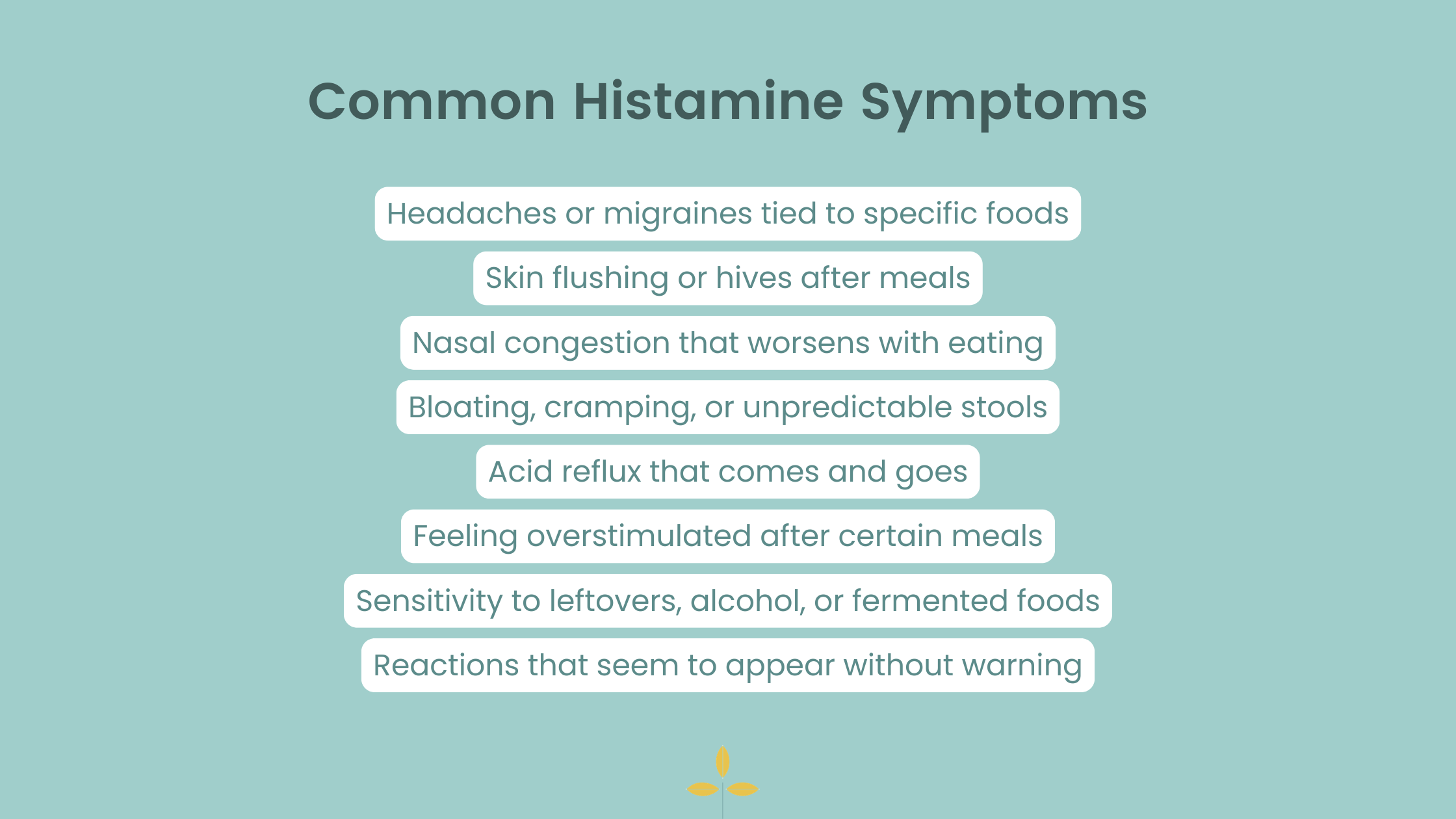
Common symptom patterns include:
- Skin flushing or hives after meals
- Headaches or migraines tied to specific foods
- Nasal congestion that worsens with eating
- Bloating, cramping, or unpredictable stools
- Acid reflux that comes and goes
- Feeling overstimulated after certain meals
- Sensitivity to leftovers, alcohol, or fermented foods
- Reactions that seem to appear without warning
These patterns are becoming increasingly common in clinical practice. Still, symptoms do not explain the root driver.
Why Food Reactions Stop Feeling Predictable
One of the biggest clues that histamine is not the whole story is inconsistency. Many clients report that they tolerated a food for years, only to suddenly begin reacting.
From a functional nutrition lens, several underlying factors can lower histamine tolerance over time.
Microbiome Imbalance
The gut microbiome plays a direct role in histamine dynamics. Some bacterial strains produce histamine while others help regulate it. When microbial balance shifts, histamine load can rise beyond what the body comfortably clears.
Digestive Inefficiency
Suboptimal stomach acid, enzyme output, or bile flow can increase food reactivity. When digestion is incomplete, larger food particles interact with the immune system more frequently.
This can amplify inflammatory signaling and symptom sensitivity over time.
Gut Barrier Stress
The intestinal lining acts as a selective filter between the gut and the immune system. When that barrier becomes irritated, immune activation tends to increase (source). Histamine is one of the key mediators involved in this response.
Chronic Stress and Nervous System Load
This piece is often underestimated. Studies show that stress influences mast cell activity and histamine release through the gut-brain axis. When the nervous system remains in a prolonged state of stress, histamine tolerance often narrows.
Taken together, these factors explain why symptoms rarely respond to food restriction alone.
Why Low-Histamine Diets Provide Short-Term Relief but Not Always Long-Term Progress
Many people feel an initial improvement on a low-histamine diet. That response makes sense because overall histamine load temporarily decreases.
Where frustration begins is several weeks or months later. Common experiences heard from Whole Essentials Nutrition clients include:
- The food list keeps shrinking
- Symptoms return during reintroduction
- Eating out becomes stressful
- Progress stalls despite strict eating
This happens because elimination diets reduce exposure but do not rebuild digestive or immune resilience. Used strategically, a low-histamine approach can be a helpful calming phase. Used indefinitely without deeper investigation, it often becomes unnecessarily restrictive.
The Role of Functional Stool Testing in Histamine Cases
At Whole Essentials Nutrition, we view testing as a way to reduce guesswork rather than as a standalone solution. Test, not guess!
Comprehensive stool analysis can help identify patterns such as:
- Microbial imbalances
- Inflammatory markers
- Digestive insufficiency
- Short-chain fatty acid production
- Opportunistic overgrowth
When interpreted in context, this information helps guide targeted support and personalized nutrition planning, rather than broad restriction.
For those working with a holistic nutritionist, this is often the point where the picture starts to make more sense.
What Supporting Histamine Sensitivity Often Looks Like
Support plans vary from person to person. Still, effective strategies typically focus on improving the gut environment rather than avoiding more foods.
Depending on the case, this may include:
- Nutrition strategies that support digestion and microbial balance
- Short-term targeted supplementation when indicated (practitioner-led)
- Nervous system regulation practices
- Structured food reintroduction over time
- Ongoing adjustment based on symptom response
The goal is to help the body regain flexibility around food instead of remaining stuck in a cycle of restriction.
How Whole Essentials Nutrition Approaches Histamine-Related Symptoms
Most people who reach out are not looking for another food list. They are looking for clarity.
At Whole Essentials Nutrition, the focus is on connecting the dots between symptoms, gut function, and daily stress load so support can be personalized and sustainable. In-person, holistic nutrition care is available for clients in Utah, and virtually for those who prefer online support.
The process integrates:
- Functional gut testing when appropriate
- Individualized nutrition strategy
- Education that builds body awareness
- Ongoing guidance as the gut stabilizes
The aim is simple: help your digestive system become more resilient so food stops feeling unpredictable.
How to Choose the Right Next Step for Healing
If histamine intolerance symptoms or unpredictable food reactions have been showing up more often, having the right level of insight can make the path forward much clearer.
The free Gut Health Assessment is often the best starting point if you:
- Are noticing new or inconsistent food reactions
- Feel unsure what your symptoms are pointing to
- Have tried basic diet changes without clear direction
- Want guidance on what your gut may be asking for next
This assessment helps identify patterns and determine whether deeper functional testing would be helpful.
The Gut Restore Assessment may be a better fit if you:
- Have been dealing with long-standing digestive concerns
- Notice reactions continuing despite careful eating
- Experience symptoms across multiple systems, such as the gut, skin, or sinus
- Are ready for comprehensive stool testing with personalized interpretation
This option includes functional stool testing and a detailed review to map out targeted next steps for your gut health.
If you are unsure where to begin, start with the free Gut Health Assessment to identify your symptom patterns and understand what level of support may be most appropriate for your situation.
Your body is often more consistent than it seems. It simply needs the right lens.
Frequently Asked Questions About Histamine Intolerance and Gut Health
Is histamine intolerance permanent?
Not necessarily. Many people notice improvement as underlying gut imbalances, digestive function, and stress patterns are supported. The goal is not long-term restriction, but helping the body rebuild tolerance capacity over time.
Can gut health issues cause hives or headaches?
They can be connected. Gut inflammation and microbiome imbalances are commonly associated with immune activation and histamine responses. When the gut environment becomes more stable, many people notice these reactions become less frequent or less intense.
Is stool testing helpful for ongoing food reactions?
For persistent or confusing symptoms, functional stool testing can provide clarity that diet changes alone often cannot. It helps identify patterns in digestion, inflammation, and microbial balance so nutrition support can be more targeted.
How do I know if I need a low-histamine diet?
A low-histamine approach can be helpful when symptoms such as flushing, headaches, or food reactions appear consistently after higher-histamine foods. It is often most useful as a short-term calming strategy while underlying gut and stress patterns are being addressed rather than as a long-term solution.
What is the connection between the gut microbiome and histamine?
Certain gut bacteria can produce histamine while others help regulate it. When the gut microbiome becomes imbalanced, histamine load can rise, and symptoms may become more noticeable. Supporting microbial balance is often an important piece of a comprehensive gut health plan.
When should I work with a holistic nutritionist for food reactions?
It may be helpful to seek support when food reactions feel unpredictable, symptoms continue despite diet changes, or multiple systems such as digestion, skin, or sinuses are involved. A holistic nutritionist can help identify patterns and guide a more personalized plan rather than relying on trial and error.
DON’T MISS THIS!
START YOUR PATH TO BETTER HEALTH
Take our free Gut Health Assessment today and discover personalized steps to improve your digestion and well-being. Don’t wait—unlock the key to a healthier you now!
