
Perimenopause Gut Health and Why Your Digestion Is Changing
Sep 21, 2026
Your body is changing, and much of it can feel like it is happening without your say. One season your cycle turns unpredictable, the next your sleep starts to fray, and somewhere along the way your digestion begins behaving like someone you no longer recognize.
That can be frightening. It can also be frustrating and overwhelming, the kind of shift that colors whole days, because when your gut feels off, little else feels right.
Maybe you used to eat a salad without a second thought, and now the same bowl leaves you bloated well into the evening. The discomfort seldom travels alone, arriving with broken sleep, brain fog, a shorter fuse and periods that keep their own schedule.
Then you bring it to an appointment and hear that your labs look fine, or that this is part of getting older. You are the one living inside your body, and it deserves to be heard.
Perimenopause reaches into nearly every system you have, digestion included, though that doesn't make hormones the whole story. Your hormones, your stress, your microbiome and the daily mechanics of digestion all move together. Perimenopause gut health becomes far easier to understand once you can see how those pieces fit.
Perimenopause Digestive Symptoms and What Changes
These changes can creep in slowly or land all at once, and they show up differently from one woman to the next. The most common ones include:
- Bloating that builds through the afternoon
- Constipation, or bowel movements that have become harder to pass
- Loose stools and urgency that arrive with little warning
- Reflux, indigestion or heaviness after meals
- Foods you once handled easily starting to sit like a stone
- Fatigue or brain fog that follows a meal
- Weight that shifts while you live much as you always have
The pattern tends to sharpen during the weeks when everything else feels demanding.
The timing varies. Some women meet these shifts in their forties, and others in their thirties. Across the transition, estrogen and progesterone stop falling in a tidy line and instead rise and dip in ways that are hard to predict. That unevenness ripples outward, so your sleep, your mood, your cycle and your digestion can all feel less steady at the same time.
The Gut-Hormone Connection in Perimenopause
Your hormones and your digestion share more wiring than most of us were ever taught. Estrogen and progesterone help set the pace at which food moves through you, and they shape how sensitive your intestines feel from one day to the next.
They also influence how well your gut lining holds its barrier and which microbes thrive inside you. The relationship runs both ways, since your gut takes part in how those same hormones are processed and cleared.
Researchers are still working out how much of this traces to hormones and how much belongs to aging, medications, stress and the other moving parts of midlife. A recent review in Nature Reviews Gastroenterology & Hepatology notes that few studies have examined digestive symptoms across the menopause transition with any depth. So we hold these connections with humility, even as we take what you feel seriously.
Some of that back-and-forth runs through your microbiome. After your liver processes estrogen, a portion of it passes into the intestine through bile. There, certain gut bacteria decide its fate, either returning it to circulation or sending it onward to be eliminated.
This community of estrogen-handling microbes has a name: the estrobolome, and researchers have traced the enzyme they produce, beta-glucuronidase, which reactivates estrogen so your body can use it again.
None of this means one bacterium balances your hormones. It means your estrogen and your microbiome shape each other constantly, which helps explain why digestion can feel so different from one week of your cycle to the next.
How Cortisol and Stress Affect Gut Health
Cortisol has a bad reputation it doesn't fully deserve. It wakes you in the morning, carries you through a hard moment, steadies your blood sugar and finds energy when your body calls for it.
Trouble begins when the stress response fires too often and gets too little chance to recover, and perimenopause makes that recovery harder to find. Night sweats interrupt your sleep, early waking shortens it, and the mental load of midlife keeps your system on alert when it would rather stand down.
When your brain reads the world as unsafe, digestion slides down its list of priorities. Your stress response can slow your gut or speed it up, change how much digestive fluid you make, and turn ordinary sensations into discomfort. It can loosen the intestinal barrier and tug your appetite and blood sugar off course.
For one woman, this means constipation that digs in, and for another, it means urgency and loose stools. Bloating and fullness tend to feel louder than they used to.
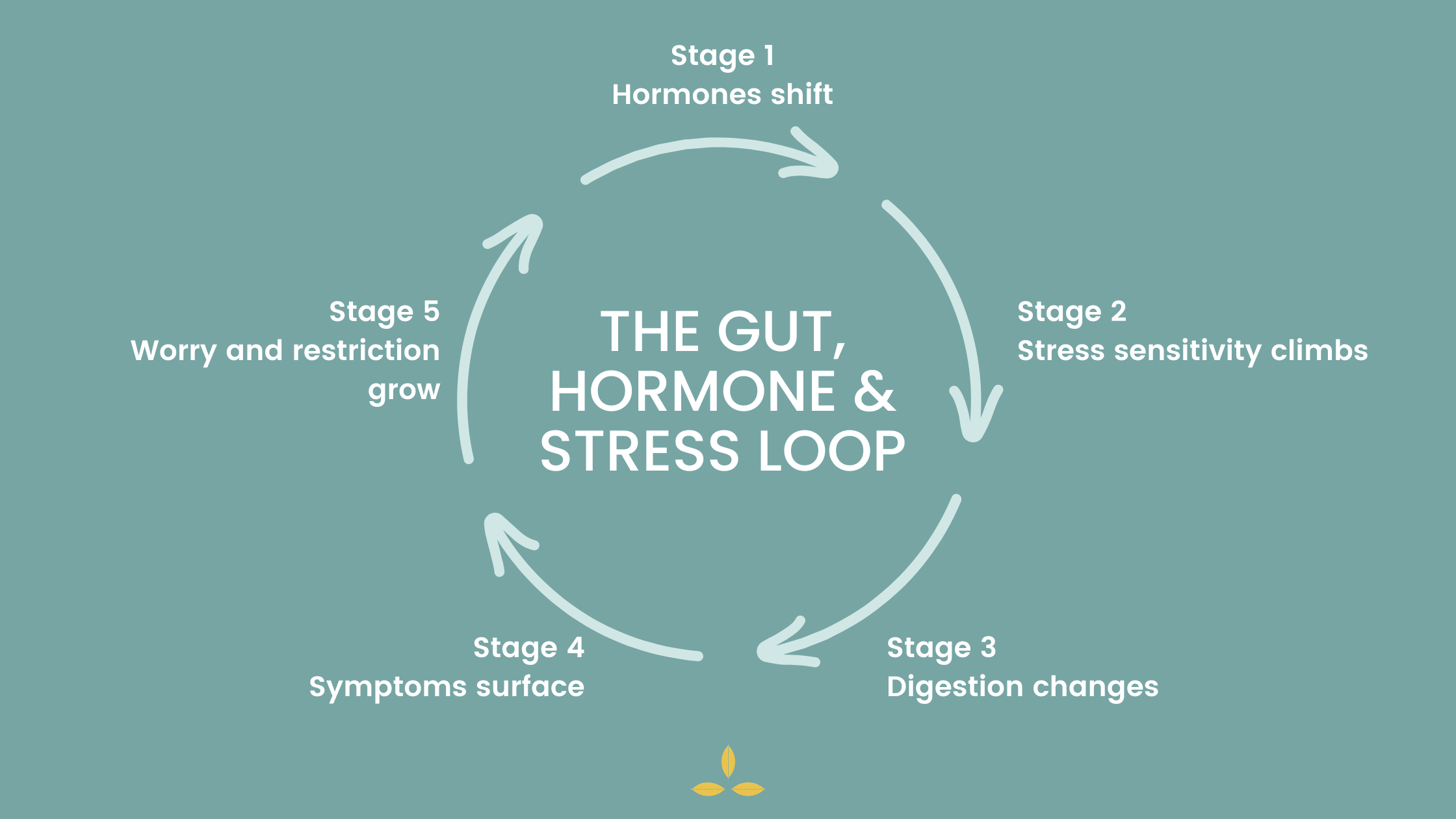
You can feel the loop close. Fluctuating hormones fray your sleep and mood and leave you more reactive to stress. That reactivity shifts how your gut moves and how you eat, which brings on bloating or constipation or reflux, which pulls you toward restriction and worry and feeds the whole thing forward again.
Naming it isn't about blame. It is about finding the one place in the cycle where a small, well-aimed change lets your body settle.
Why Cutting Foods Won't Fix Perimenopause Bloating
When digestion turns unpredictable, the instinct is to start taking things away. Dairy goes first, then gluten, then beans and grains and fruit and cruciferous vegetables, until the plate keeps shrinking and the safe list keeps getting shorter.
Elimination has its place when it is targeted, time-limited, and followed by a careful reintroduction. On its own, though, restriction seldom delivers the healing you are hoping for.
Cut too far, and your meals lose fibre, diversity and the nutrients your body counts on, which can worsen constipation and make every meal feel like a chore. When symptoms hold steady despite clean eating and probiotics and one more food removed, your body is asking for information, and a stricter plate has none to give.
How Gut Testing Brings Clarity to Perimenopause Symptoms
A comprehensive stool test won't tell you if you are in perimenopause, and it won't weigh in on hormone therapy. It can show how well your digestion is working on its own terms, so we can see whether it is quietly adding to what you feel.
Depending on the panel, comprehensive stool testing can look at:
- The balance of your gut microbes, including any overgrowth
- How well you break down and absorb fat
- The enzyme output from your pancreas
- Signs of intestinal inflammation
- Stress on the gut lining, and how your gut immune system is responding
- Pathogens you had no reason to suspect
Testing earns its keep when it turns scattered guessing into a plan shaped around you. It might show that you are absorbing fat poorly, or that low digestive output or a microbial imbalance sits underneath the bloating and the irregularity.
The value is simple. It replaces trial and error with direction, and direction is the whole promise of test, don't guess.
What A Root-Cause Perimenopause Gut Health Plan Looks Like
When building out a gut health plan for my perimenopausal clients, I like to focus on the fundamentals below:
Build meals that satisfy.
No single perimenopause diet fits every woman, though a few principles serve most bodies well. Satisfying meals come first, built from protein, fibre-rich carbohydrates, healthy fats, and colour on the plate.
That balance steadies blood sugar, keeps things moving, feeds a diverse microbiome, and supports how your body handles estrogen. When constipation or bloating or an overgrowth is already in play, fibre climbs best in small steps instead of all at once.
Support regular elimination.
Regular elimination responds to the basics done consistently: water, enough food, daily movement, fibre, and magnesium suited to you. A bowel movement once or twice a week is a signal to look closer, not a verdict you have to accept as your new normal.
Ease stress without self-blame.
Stress belongs in the plan too, with no suggestion that you brought this on yourself. Steadier sleep helps, and so do protected downtime and regular mealtimes. A few slow breaths before you eat, a walk outside, and lighter commitments each tell your nervous system it is safe to move from guarding into rest and digest.
Choose supplements with intention.
Supplements come last, and only when they fit. Probiotics, enzymes, bile support, antimicrobials, and gut-lining nutrients each do different work, so the right one depends on your symptoms, your history, your medications, and what testing shows. More bottles seldom mean better results.
Coordinate gut and hormone care.
Because perimenopause reaches past digestion, and digestion reaches past hormones, gut care and hormone care work best side by side. My colleague Dr. Katie Brussard, ND, walks women through changing hormones and the signs of this transition that so often get missed. Her article, Perimenopause in Your 30s and 40s: Symptoms Women Miss, is a lovely place to understand the wider hormonal picture.
How I Support Women Through This At Whole Essentials Nutrition
At Whole Essentials Nutrition, I work with women who can feel that something has changed. They are tired of being told that everything looks fine, or that the fix is to eat less, move more, and make peace with discomfort.
In my Gut Restore Program, we look at the whole picture together. Your symptoms and history, your sleep and stress, the way you eat, and your bowel habits all belong in the same conversation. So does the testing that fits, and so does what can hold up in the middle of an ordinary week.
Testing folds into that work when it belongs, and it never replaces listening to you. It is one input among several, and never a shortcut sold on its own. What I am after is the reason your digestion is struggling, and a phased, doable plan that carries you through this stretch with more comfort and far less guessing.
Start With A Gut Clarity Call
Your body is in transition, and that doesn't sentence you to years of bloating, restriction, and second-guessing every meal. A Gut Clarity Call is a space to talk through what you are living with, what you have already tried, and if a fuller gut-health approach is right for your next chapter.
When to check in with your medical provider
Hormones can shape digestion, and new or stubborn symptoms still deserve a proper look beyond a perimenopause label. Reach out to your medical provider promptly if any of these show up:
- Blood in your stool
- Black or tarry stool
- Persistent vomiting
- Severe or worsening abdominal pain
- Unexplained weight loss
- Fever
- New anemia
- Difficulty swallowing
- A sudden, marked change in bowel habits
- Any bleeding after 12 months without a menstrual period
Frequently Asked Questions
Can hormone therapy improve perimenopausal digestive symptoms?
Hormone therapy is prescribed mainly for hot flushes, sleep disruption, and mood, and some women notice their digestion settles alongside those improvements. Evidence focused squarely on gut symptoms remains thin, so results vary from person to person. A conversation with your prescriber, paired with attention to digestion itself, serves you better than expecting hormones to resolve gut symptoms on their own.
Do these digestive changes ease after menopause?
For some women, symptoms calm once hormones stabilize on the far side of the transition, while others carry digestive changes into the postmenopausal years. Sleep, stress, the microbiome, and overall gut function all shape where you land, which is one reason tending to those foundations now can pay off well past your final period.
How do I tell perimenopausal digestion from IBS or SIBO?
They overlap enough that symptoms alone seldom separate them, and it is possible to have more than one at once. Perimenopause can amplify an existing pattern like IBS, and conditions such as SIBO can drive bloating that hormones then magnify. Sorting this out usually calls for a fuller history and, at times, testing, so you can aim support where it belongs instead of treating the wrong target.
Should I take a probiotic for perimenopause bloating?
A probiotic helps some women and does little for others, and the strain, the dose, and your particular gut picture all decide the outcome. Reaching for a general one when bloating has other drivers, like slowed motility or overgrowth, can leave you frustrated. One chosen with a specific reason behind it, ideally guided by your symptoms or testing, gives you a far better shot at benefit.
Do coffee and alcohol make perimenopausal digestion worse?
Both can, though the degree is personal. Alcohol irritates the gut lining, disturbs sleep, and worsens reflux, and it can feel harder to tolerate as you move through this stage. Coffee stimulates the colon and can help or aggravate depending on your pattern, and on an empty, stressed morning it can add to that jittery, urgent feeling. Noticing your own response and adjusting timing and amount usually beats cutting either one out.
Should I try gut testing or see my doctor first?
Let your symptoms set the order. Red-flag signs, like the ones listed above, mean your medical provider comes first, always. For persistent, disruptive digestive symptoms without those alarm features, functional gut testing inside a coaching relationship can give us the detail to build a targeted plan. The two paths support each other, and good care keeps medical evaluation and gut-focused work in conversation.
DON’T MISS THIS!
START YOUR PATH TO BETTER HEALTH
Take our free Gut Health Assessment today and discover personalized steps to improve your digestion and well-being. Don’t wait—unlock the key to a healthier you now!
